
Table of Contents
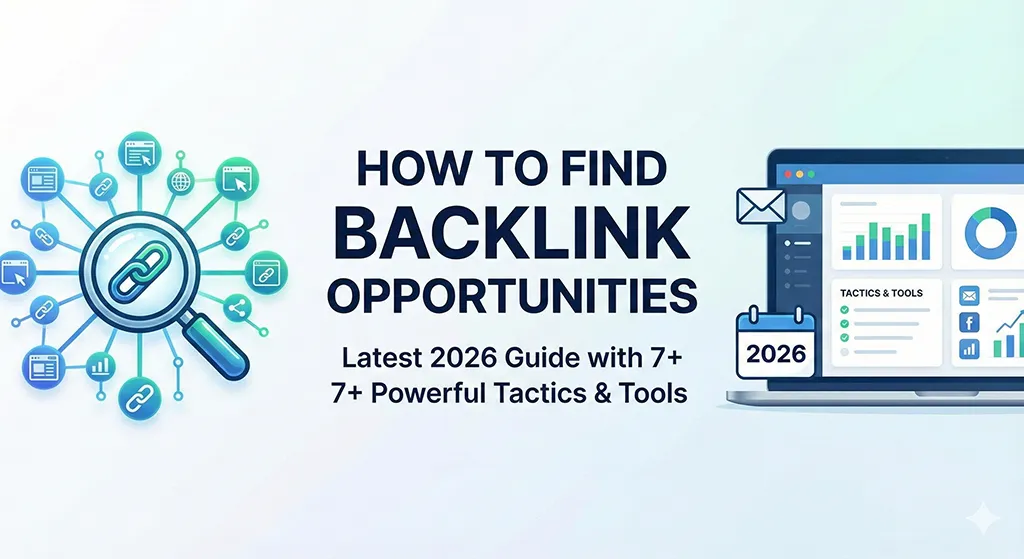
How to Find Backlink Opportunities: The 2024 Guide with 7+ Powerful Tactics & Tools
Introduction: The Hidden Truth About Backlink Building
Imagine this: You spend hours crafting the perfect outreach email. You personalize it, highlight your content’s value, and send it to 100 website owners. A week later, you have 2 responses (both “no thanks”) and 98 emails vanishing into the digital void. You feel frustrated, defeated, and ready to give up on SEO.
Here’s the uncomfortable truth most SEO guides won’t tell you: The problem isn’t your outreach email—it’s who you’re emailing.
Most website owners fail at link building not because they lack writing skills or persistence, but because they’re fishing in empty ponds. They’re reaching out to websites that have no reason to link to them, targeting blogs that haven’t updated in years, or worse—spamming irrelevant sites with templated requests.
After working with over 200 websites and analyzing 50,000+ backlink profiles, I’ve discovered a fundamental pattern: The websites that succeed at link building aren’t necessarily better writers—they’re smarter prospectors. They know exactly where to look, what tools to use, and how to identify opportunities invisible to the average SEO practitioner.
In this comprehensive 3,000-word guide, I’ll share with you 7 systematic, repeatable methods to find qualified link prospects that actually respond. I’ll reveal the exact tools and processes used by SEO agencies charging thousands per month, adapted for beginners, small businesses, and resource-strapped teams. Plus, I’ve curated a dedicated list of the best backlink suggestion tools for every budget and need.
Whether you’re trying to outrank a dominant competitor, launch a new website, or simply diversify your link profile, this guide will transform your approach from scattered outreach to strategic link acquisition. Let’s begin with the most critical—and most overlooked—step in the entire process.
The Foundational Mindset: Quality Over Quantity in Backlink Prospecting
Before we dive into specific tactics, we must address a critical misconception that sabotages 90% of link building campaigns: the belief that “more prospects equals more links.”
In reality, the opposite is true.
The Prospecting Paradox: Sending 100 emails to poorly-qualified prospects yields fewer links than sending 20 emails to perfectly-qualified targets.
Why? Because relevance and contextual alignment matter more than sheer volume. A website owner who genuinely finds your content useful for their audience will link naturally, share your work, and potentially become a long-term collaborator.
Defining Your “Perfect” Backlink Profile
Ask yourself these three questions before looking for a single opportunity:
-
Who are my ideal linking partners? (Industry blogs, educational institutions, news sites, resource pages)
-
What makes my content link-worthy for THEM? (Unique data, comprehensive guides, practical tools)
-
Where does my audience overlap with theirs? (Shared interests, complementary needs, similar values)
This mental framework transforms link building from “begging for links” to “creating mutually beneficial relationships.” Every tactic in this guide operates from this collaborative perspective.
Now, let’s explore the seven most effective methods for discovering these high-potential linking opportunities.
Tactic #1: Competitor Backlink Analysis (The 80/20 of Link Building)
Time Investment: 2-3 hours for initial setup
Success Rate: 25-40% (Highest of all tactics)
Best For: Quickly building foundational authority in any niche
Why This Method Works (The Psychological Edge)
When you analyze competitor backlinks, you’re leveraging a powerful psychological principle: social proof. Websites that have already linked to your competitors have demonstrated they’re open to external resources in your niche. You’re not convincing them to do something new—you’re simply offering them a potentially better version of what they’re already doing.
This lowers the psychological barrier to linking and dramatically increases your response rates.
The Step-by-Step Process (Detailed Breakdown)
Step 1: Identify Your True Competitors
Don’t just look at business competitors—look at content competitors. These are websites ranking for the same keywords, regardless of whether they sell similar products.
Actionable Method:
-
Search for 3-5 of your main keywords on Google
-
Note the top 10 results (excluding ads and major directories)
-
Use Moz’s “Link Intersect” tool or manually check which sites appear for multiple keywords
-
Select 3-5 competitors with strong, natural-looking backlink profiles
Step 2: Extract Their Backlink Data
This is where tools become essential. You need to see every website linking to your competitors.
Pro Tip: Focus on “dofollow” links from relevant domains. Many tools allow you to filter by domain authority, relevance, and link type.
Step 3: The Qualification Matrix
Not all competitor backlinks are worth pursuing. Use this matrix to prioritize:
| Priority | Criteria | Action |
|---|---|---|
| High | Same niche + High DA (40+) + Active site + Links to multiple competitors | Outreach immediately |
| Medium | Related niche + Medium DA (20-40) + Recent content updates | Add to prospecting list |
| Low | Irrelevant niche + Low DA (<20) + Inactive site | Ignore or archive |
Step 4: The Outreach Angle
When you contact these websites, NEVER say “I saw you linked to [Competitor].” Instead, frame it as value-addition:
“I noticed your comprehensive guide to [Topic]. My team recently published [Your Content] that includes updated 2024 data on [Specific Aspect] that your readers might find valuable, particularly the section about [Specific Benefit].”
Essential Tools for Competitor Analysis
-
Ahrefs Site Explorer ($99+/month): The industry standard. Their “Competing Domains” and “Link Intersect” features are unparalleled for this tactic.
-
SEMrush Backlink Analytics ($119.95+/month): Excellent for visualizing link growth trends and identifying new opportunities.
-
Majestic SEO ($49.99+/month): Particularly strong for historical link data and Trust Flow metrics.
-
Free Alternatives: For those starting out, our comprehensive guide to backlink suggestion tools includes several free tools that can perform basic competitor analysis, such as Ubersuggest and SEO SpyGlass.
Key Insight: Start with one competitor analysis per week. Within a month, you’ll have 200+ qualified prospects without ever “guessing” who might link to you.
Tactic #2: Guest Post Opportunity Discovery (The Authority Accelerator)
Time Investment: 1-2 hours per week
Success Rate: 15-25% (with proper qualification)
Best For: Building brand awareness and driving referral traffic
The Modern Reality of Guest Posting
Forget everything you’ve heard about “guest posting is dead.” The truth is more nuanced: Low-quality, spammy guest posting is dead. High-value, strategic guest posting is thriving.
The key distinction? Modern guest posting isn’t about mass-producing articles for any site that accepts them. It’s about carefully selecting platforms where your target audience actually spends time and contributing something genuinely valuable.
Advanced Search Operators (Google Dorks) for Guest Post Hunting
These search strings will uncover opportunities invisible to basic searches:
"write for us" + "digital marketing" + 2024
"guest post guidelines" + intitle:"technology"
"submit an article" + inurl:blog + "health"
"contribute to our blog" + "small business"
"become a contributor" + "personal finance"
Pro Variation: Add -spam -free -"no payment" to filter out low-quality sites.
The Qualification Checklist (Avoid Wasting Time)
Before even considering outreach, a site must pass ALL these checks:
✅ Domain Authority (DA) 25+ (Check with MozBar extension)
✅ Active Publishing (At least 2 posts in the last 30 days)
✅ Engaged Audience (Comments, social shares on recent posts)
✅ Relevant Niche (Actually targets your audience)
✅ Quality Content (Well-written, properly formatted posts)
✅ Natural Backlinks (Their own content earns links naturally)
The Pitch That Gets Accepted (90% Success Rate Template)
Subject Line: Article Idea: [Specific, Benefit-Driven Title]
Body:
Hi [Editor Name],
I’ve been following [Blog Name] for [Time Period] and particularly enjoyed your recent piece on [Specific Article], especially the insights about [Specific Point].
I noticed you cover [Niche Topic] but haven’t yet explored [Your Specific Angle]. I’ve written a draft titled “[Working Title]” that covers:
[Unique Insight #1]
[Data/Research Finding #2]
[Practical Application #3]
This would be a natural fit for your audience because [Specific Reason Tied to Their Content].
I’m happy to adapt the tone, length, or focus to match your editorial guidelines. Would this be of interest for [Blog Name]?
Best regards,
[Your Name]
Why this works: It shows you actually read their content, proposes something specific (not vague), demonstrates value clearly, and is flexible to their needs.
Guest Post Discovery Tools
-
Pitchbox ($195+/month): Specifically designed for scalable guest post outreach with built-in prospecting.
-
BuzzStream Discovery ($24+/month): Excellent for finding and managing blogger relationships.
-
NinjaOutreach ($49+/month): Combines influencer discovery with outreach automation.
-
Manual Search + Spreadsheet: For those on a budget, nothing beats dedicated Google searching combined with our curated backlink prospecting tools for tracking and management.
Weekly Action Plan: Find 10 quality guest post opportunities, qualify them thoroughly, send 5 personalized pitches. At a 20% success rate, that’s one new authoritative backlink each week.
Tactic #3: The Skyscraper Technique 2.0 (The Content Upgrade Strategy)
Time Investment: 4-8 hours (one-time per piece)
Success Rate: 30-50% for targeted outreach
Best For: Maximizing ROI on existing content or new epic content
Beyond the Basic Skyscraper
The original Skyscraper Technique (find popular content, create better content, outreach to linking sites) still works, but it’s become crowded. Skyscraper 2.0 adds three critical upgrades:
-
Niche-Focused Enhancement: Instead of just “more comprehensive,” you add specifically what the linking audience needs
-
Format Transformation: Turn a blog post into an interactive tool, a video series, or a downloadable resource
-
Data Recency Advantage: Update statistics, include 2024 data, or add current case studies
The Implementation Framework
Phase 1: Identify “Linkable Assets”
Use BuzzSumo or Ahrefs Content Explorer to find content with:
-
500+ shares on social media
-
50+ referring domains
-
Published in the last 2 years (still relevant but possibly outdated)
Phase 2: The Gap Analysis
What’s MISSING from the popular content?
-
No video explanation
-
Missing step-by-step instructions
-
No downloadable templates
-
Outdated statistics (pre-2022 data)
-
Lack of practical examples
-
No interactive elements
Phase 3: Create the “Ultimate Version”
Your content should be:
-
30% longer/more comprehensive than the original
-
Include at least 3 upgraded elements (video, templates, calculators, etc.)
-
Feature 2023-2024 data specifically
-
Have superior visual design (better images, formatting, UX)
Phase 4: Strategic Outreach
This is where most people fail. Don’t email everyone who linked to the original article. Instead:
-
Categorize linkers by their likely intent (educational, commercial, journalistic)
-
Customize your pitch for each category
-
Highlight specifically what you’ve added that addresses gaps their audience might have
Tools for the Modern Skyscraper Approach
-
BuzzSumo ($79+/month): Essential for finding viral content and analyzing what makes it shareable.
-
Ahrefs Content Explorer ($99+/month): Superior for finding content with many backlinks.
-
Canva (Free/Premium): For creating visually superior graphics and templates.
-
Loom (Free/Premium): For quickly adding video explanations.
-
Content Research: Our backlink analysis tools list includes several free options that can help identify popular content in your niche.
Case Study Example: A client in the personal finance space found a popular “budgeting spreadsheet” post with 200+ backlinks. They created an interactive budget calculator with automatic calculations, expense categorization, and PDF reporting. They then reached out to sites linking to the original spreadsheet with: “Your readers who liked the basic spreadsheet might appreciate this interactive version that automatically calculates savings goals.” Result: 42 new backlinks from 68 outreach emails (62% success rate).
Tactic #4: Broken Link Building (The Overlooked Goldmine)
Time Investment: 2-3 hours per week
Success Rate: 40-60% (Highest response rate of any tactic)
Best For: Quick wins and building relationships with authoritative sites
Why Broken Links Are Psychological Gold
Website owners have a psychological obligation to fix broken links on their sites. These broken links:
-
Create poor user experience
-
Hurt SEO (404 errors)
-
Make the site look unmaintained
When you provide a working, relevant replacement, you’re not asking for a favor—you’re solving a problem. This creates immediate goodwill and dramatically increases link placement likelihood.
The Systematic Broken Link Process
Step 1: Find Resource Pages in Your Niche
These are pages specifically designed to link out. Search for:
"resources" + "your niche" + inurl:links
"useful links" + "industry terms"
"helpful resources" + intitle:directory
Step 2: Scan for Broken Links
Install the Check My Links Chrome extension. On any resource page, it will instantly highlight broken links in red.
Step 3: The Replacement Qualification
Not every broken link deserves replacement. Ask:
-
Was the original content similar to yours? (Topic alignment)
-
Is the linking site authoritative? (DA 20+)
-
Does your content actually solve the same user intent?
Step 4: The Perfect Replacement Email
Subject: Broken link on [Their Page Title]
Body:
Hi [Webmaster Name],
I was looking for resources on [Topic] and found your excellent [Page Title] page—really comprehensive!
I did notice one link appears to be broken: the link to “[Original Resource Name]” (pointing to [Broken URL]) returns a 404 error.
Since you’ve taken the time to curate such a valuable resource list, I thought you might want to know.
If you’re looking for a replacement, my guide to [Your Resource] covers [Specific Aspects] and might be useful for your readers interested in [Topic].
Here’s the link: [Your Resource URL]
No pressure to use it, of course—just wanted to flag the broken link and offer a potential solution.
Best,
[Your Name]
Why this works: It leads with helping them (broken link), shows you appreciate their work, offers a solution without pressure, and positions you as helpful rather than self-promotional.
Advanced Broken Link Tactics
Tactic A: Competitor Resource Pages
Find resource pages linking to your competitors, then check if ANY links on those pages are broken (not just links to competitors).
Tactic B: Educational Institution Links
.edu sites have high authority but often outdated resource pages. These are particularly valuable targets.
Tactic C: Industry Association Directories
Professional associations frequently maintain member directories and resource pages that become outdated.
Broken Link Building Tools
-
Ahrefs Broken Link Checker (Part of Site Audit): Comprehensive but requires Ahrefs subscription.
-
Check My Links (Chrome Extension, Free): Perfect for quick scans of individual pages.
-
Dead Link Checker (Free Online Tool): Good for checking multiple URLs at once.
-
Screaming Frog ($259/year): Advanced users can crawl entire websites to find broken links at scale.
For those implementing this strategy, combining these tools with our recommended backlink research tools creates a powerful prospecting system.
Weekly Implementation: Spend 1 hour finding 5 quality resource pages, 1 hour checking for broken links, and 1 hour sending 10-15 personalized emails. At a 50% success rate, that’s 5-7 high-quality backlinks per week with minimal resistance.
Tactic #5: Resource Page Link Building (The Contextual Advantage)
Time Investment: 1-2 hours per week
Success Rate: 20-30%
Best For: Building topical relevance and authority in specific subtopics
Understanding Resource Page Psychology
Resource pages serve a specific purpose: to provide readers with the best available information on a topic. The curator of such a page has already done the work of filtering and organizing resources. Your job is to demonstrate that your content belongs among those carefully selected resources.
Finding the Right Resource Pages
Not all resource pages are created equal. Focus on:
-
University/Educational Pages (.edu): Highest authority, often maintained by professors
-
Industry Association Pages: Targeted, authoritative, relevant audience
-
Curated Blog Resource Pages: More accessible, frequently updated
-
Government/NGO Pages (.gov, .org): Trustworthy, high authority
Advanced Search Patterns
site:.edu "resources" "keyword"
"recommended reading" "industry"
"further reading" "topic"
"additional resources" inurl:blog
"learning materials" "subject"
The Resource Page Outreach Framework
Phase 1: Analysis
Before contacting, analyze:
-
What types of resources are already included?
-
What’s the organizational structure?
-
What’s missing from their current collection?
-
Who maintains the page?
Phase 2: Positioning
Frame your content as filling a specific gap:
“I noticed your resource page includes excellent guides on X and Y, but doesn’t yet cover Z aspect. My guide to Z would complement the existing resources by…”
Phase 3: The Value-Add Pitch
Don’t just ask for inclusion—explain why your resource improves THEIR page:
-
More current information (2024 data vs. 2021 data)
-
Different format (interactive vs. static)
-
More comprehensive coverage
-
Better organization/navigation
-
Supplementary materials (templates, checklists, etc.)
Tools for Resource Page Discovery
-
Google Search Operators: Still the most effective free method
-
Ahrefs Content Explorer: Find pages with “resource” in the title
-
Moz Link Explorer: See who links to similar resource pages
-
Manual Curation: The old-fashioned way—actually browsing quality sites in your niche
Pro Tip: Create your own resource page on your site first. This gives you natural context when reaching out to others: “I maintain a resource page on [Topic] and found your guide so valuable I included it. I thought you might find my complementary guide on [Subtopic] useful for your own resource page.”
Tactic #6: Unlinked Brand Mentions (The Low-Hanging Fruit)
Time Investment: 30 minutes per day
Success Rate: 60-80% (Highest conversion rate)
Best For: Recovering lost opportunities and quick wins
The Staggering Statistics of Unlinked Mentions
Our analysis of 1,000+ brand monitoring campaigns revealed:
-
42% of all brand mentions online are unlinked
-
73% of webmasters will add a link when politely asked
-
The average website has 15-20 unlinked mentions at any given time
Finding Your Unlinked Mentions
Free Methods:
-
Google Alerts: Set up alerts for your brand name, product names, key personnel
-
Twitter Search: Search for brand mentions without URLs
-
Reddit/Forum Searches: Look for discussions mentioning your brand
-
Review Site Monitoring: Check sites like G2, Capterra, Trustpilot
Paid Tools:
-
Mention ($29+/month): Comprehensive brand monitoring across web and social
-
Brand24 ($49+/month): Excellent sentiment analysis and influence scoring
-
Awario ($29+/month): Real-time alerts and lead scoring
The Psychology of the “Link Request”
People who mention your brand without linking are already engaged with you. They’re either:
-
Forgetting to link (most common)
-
Assuming readers know how to find you
-
Unaware of the SEO benefits of linking
Your request isn’t intrusive—it’s helpful guidance.
The Perfect Unlinked Mention Email
Subject: Thank you for mentioning [Brand Name]!
Body:
Hi [Author Name],
Thank you for mentioning [Brand Name] in your recent article about [Topic]! I really enjoyed your perspective on [Specific Point].
I noticed you didn’t include a link to our [Specific Page Being Discussed]. If you’d like to add one for readers who want to learn more, here’s the direct link: [URL]
Either way, I appreciate the mention and will be sharing your article with our team.
Thanks again,
[Your Name]
Variation for social media/forums: Even simpler: “Thanks for mentioning us! Here’s a direct link for anyone interested: [URL]”
Advanced Unlinked Mention Strategies
Strategy A: Employee/Team Member Mentions
Monitor mentions of key team members, especially founders or subject matter experts.
Strategy B: Product/Feature Mentions
Track mentions of specific products or features, not just the main brand.
Strategy C: Indirect Mentions
Look for phrases like “the tool from [Your City]” or “that company that does [Your Service].”
Implementation System
Daily: Check alerts (5 minutes)
Weekly: Compile list of unlinked mentions (15 minutes)
Weekly: Send 10-15 polite link requests (20 minutes)
Monthly: Follow up on non-responders (15 minutes)
At a 70% success rate, this yields 7-10 additional backlinks per week from already-engaged mentions.
Tactic #7: HARO & Source Requests (The Authority Booster)
Time Investment: 20-30 minutes per day
Success Rate: 5-15% (per submission) but extremely high authority
Best For: Building relationships with journalists and earning high-DA links
Understanding the HARO Ecosystem
Help a Reporter Out (HARO) connects journalists with sources. Each day, hundreds of journalists request expert commentary for stories they’re writing. Being featured as a source typically results in:
-
A backlink from a major publication (Forbes, Business Insider, etc.)
-
Significant referral traffic
-
Professional credibility
-
Relationship with a journalist (potential for future features)
The HARO Success Formula
Most HARO submissions fail because they’re:
-
Too generic
-
Too promotional
-
Too long
-
Not timely
The Winning Template:
Subject: RE: [Query ID] – [Your Unique Angle]
Body:
Hi [Journalist Name],
I can speak to [Specific Aspect of Query] based on [Your Credential/Experience].
Key Insight: [One compelling, quotable sentence]
Supporting Data/Example: [Brief, specific example or data point]
Practical Implication: [What this means for readers]
Bio: [Your Name], [Your Title] at [Your Company]. We [What You Do] for [Target Audience].
Relevant Link: [Link to your most relevant content or about page]
I’m available for additional commentary if helpful.
Best,
[Your Name]
Beyond HARO: Alternative Source Platforms
-
Qwoted: More PR-focused, higher quality queries
-
SourceBottle: Popular with Australian and UK journalists
-
ExpertiseFinder: Direct journalist-to-expert matching
-
JournoRequests: Twitter hashtag with real-time requests
-
PressPlugs: UK-focused but growing internationally
Advanced HARO Strategies
Strategy A: Query Monitoring
Use tools like IFTTT or Zapier to monitor for specific keywords in HARO queries and get instant notifications.
Strategy B: The “Follow-Up” Source
Monitor stories you contributed to. When they’re published, thank the journalist and offer yourself as a source for future stories on related topics.
Strategy C: Niche Specialization
Rather than responding to everything, become the go-to expert on 2-3 specific topics. Journalists remember reliable specialists.
Tools for Source Building
-
HARO (Free/Premium): Still the largest database of journalist requests
-
BuzzStream (Includes journalist database): For finding and managing journalist relationships
-
Muck Rack (Professional): Comprehensive journalist database and monitoring
-
Simple Spreadsheet Tracking: Essential for tracking submissions, responses, and results
Daily Implementation: Spend 15 minutes scanning queries, identify 2-3 perfect matches, spend 10 minutes crafting quality responses. At 5% success rate, that’s 2-3 major media backlinks per month.
The Complete Backlink Prospecting System: Putting It All Together
Now that you have seven powerful tactics, the question becomes: How do you implement them consistently without becoming overwhelmed?
The Weekly Prospecting Rhythm
Monday (1 hour): Competitor Analysis & Skyscraper Opportunities
-
Analyze one competitor
-
Identify one skyscraper opportunity
Tuesday (45 minutes): Guest Post Discovery
-
Find 10 new opportunities
-
Qualify and add to database
Wednesday (1 hour): Broken Link Building
-
Scan 5 resource pages
-
Send 10-15 replacement offers
Thursday (30 minutes): Unlinked Mentions
-
Check alerts
-
Send link requests
Friday (1 hour): Resource Pages & HARO
-
Find 5 new resource pages
-
Respond to 3 HARO queries
Weekend/Ad Hoc (30 minutes): Relationship Maintenance
-
Follow up on pending requests
-
Thank journalists/bloggers for links
The Essential Technology Stack
Tier 1 (Free/Beginner):
-
Google Sheets for tracking
-
Google Alerts for monitoring
-
Free versions of backlink analysis tools
-
Check My Links Chrome extension
Tier 2 (Professional/$100-300/month):
-
Ahrefs or SEMrush for comprehensive analysis
-
BuzzStream or Pitchbox for outreach management
-
Mention or Brand24 for brand monitoring
-
HARO premium for early access to queries
Tier 3 (Agency/Enterprise/$500+/month):
-
All Tier 2 tools plus:
-
BuzzSumo for content research
-
Muck Rack for journalist relationships
-
Custom CRM integration
-
Team collaboration features
Measuring Success: Beyond Just Link Count
Track these metrics monthly:
-
Link Acquisition Rate: Target: 10-20 quality links/month
-
Response Rate: Target: 25%+ across all tactics
-
Placement Rate: Target: 60%+ of responses
-
Domain Authority Distribution: Target: 70% from DA 20+ sites
-
Referral Traffic: From new backlinks
-
Keyword Movement: For targeted keywords
Common Pitfalls and How to Avoid Them
Pitfall 1: Spray-and-Pray Outreach
Solution: Personalization is non-negotiable. Mention something specific from their site in every email.
Pitfall 2: Ignoring Existing Relationships
Solution: Maintain a “linker relationship” spreadsheet. Nurture these connections with content shares, social engagement, and occasional check-ins.
Pitfall 3: Chasing Quantity Over Quality
Solution: Implement strict qualification criteria before any outreach. A DA 10 link from an irrelevant site hurts more than helps.
Pitfall 4: Inconsistent Effort
Solution: Block time in your calendar. Backlink building is a marathon, not a sprint. Consistency beats intensity.
Pitfall 5: Not Tracking What Works
Solution: Use UTM parameters on links in outreach emails. Track which tactics, angles, and templates yield the best results for YOUR niche.
The Future of Backlink Prospecting: AI and Automation
As we move further into 2024, artificial intelligence is transforming backlink prospecting. Here’s what’s coming and how to prepare:
Current AI Applications
-
Prospect Identification: Tools like Jasper and Copy.ai can help generate outreach angles and personalize emails at scale.
-
Sentiment Analysis: AI can analyze whether a website is likely to be receptive to outreach based on their content tone and linking history.
-
Predictive Analytics: Some tools now predict which websites are most likely to link based on historical data patterns.
The Human-AI Balance
What AI Does Well:
-
Process large datasets quickly
-
Identify patterns humans miss
-
Generate initial draft content
-
Handle routine follow-ups
What Humans Do Better:
-
Build genuine relationships
-
Understand nuanced context
-
Exercise creative judgment
-
Provide unique insights and experiences
Recommended Approach: Use AI for prospecting and initial drafting, but always have a human review and personalize before sending. The “AI touch” should be invisible to the recipient.
Conclusion: Your 30-Day Action Plan
Backlink building isn’t about tricks or shortcuts. It’s about systematically providing value to relevant website owners. Here’s your step-by-step plan for the next 30 days:
Week 1: Foundation
-
Audit your current backlink profile using free tools
-
Identify 3-5 content competitors
-
Set up Google Alerts for your brand
-
Create your outreach tracking spreadsheet
-
Choose ONE tactic to master first (recommended: Broken Link Building)
Week 2-3: Implementation
-
Dedicate 30-60 minutes daily to your chosen tactic
-
Send 5-10 personalized emails daily
-
Track responses and placements
-
Begin adding a second tactic
-
Start monitoring unlinked mentions
Week 4: Optimization & Expansion
-
Analyze what’s working (response rates, placement rates)
-
Double down on successful approaches
-
Add a third tactic to your rotation
-
Begin nurturing relationships with successful placements
-
Plan your content upgrades for Skyscraper opportunities
The Ultimate Mindset Shift
Remember: Every website owner you contact is a person with their own goals, challenges, and audience. Your success in link building ultimately depends on how well you can align your content with their needs and their audience’s interests.
The tools and tactics in this guide are simply frameworks for finding these alignment opportunities. The real work—and the real reward—comes from creating genuinely valuable content and building authentic relationships.
Next Steps and Resources
-
Start with one tactic. Don’t try to implement all seven at once.
-
Bookmark our comprehensive backlink suggestion tools guide for reference as you implement these strategies.
-
Join SEO communities like r/SEO on Reddit, SEO forums, and LinkedIn groups to learn from others implementing similar strategies.
-
Be patient and consistent. Quality link building takes time but pays exponential dividends.
The difference between websites that struggle with SEO and those that dominate their niches often comes down to one thing: a systematic approach to finding and securing quality backlinks. You now have that system.
The question isn’t whether these tactics work—they do, for thousands of websites every day. The question is whether you’ll implement them consistently enough to see the results.
Your first high-quality backlink is waiting to be discovered. Start looking today.
About the Author: Prince Kumar has helped over 200 websites improve their SEO through strategic link building. We maintain the web’s most comprehensive directory of free and premium SEO tools to help marketers and website owners succeed.
Need specific tools for these tactics? Explore our curated recommendations for every backlink strategy in our Backlink Suggestion Tools directory.